When training becomes crowd management
Let us talk about Excel.
Once again, the diving community is discussing how many students a single instructor can genuinely train effectively underwater. Different numbers are being proposed, while standards, experience and different training models are being compared.
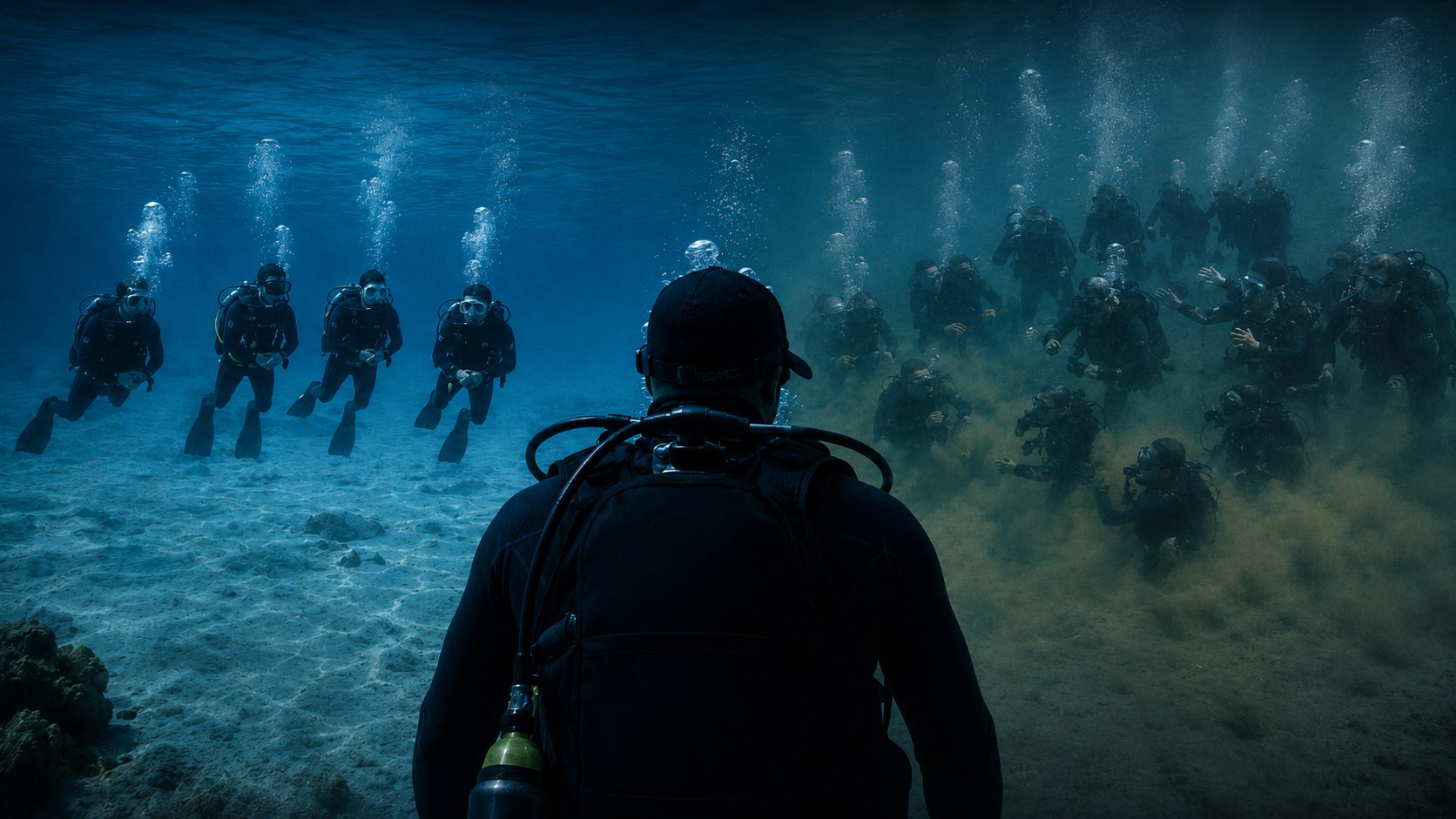
Ultimately, however, the question is very simple: at what point does a training group stop being a training group and become a crowd that the instructor is merely trying to keep under control?
It is a good and necessary discussion.
The number alone does not solve everything, of course, but it sets the boundary from which the conversation about training quality, instructor attention and the genuine ability to observe every participant begins.
Does a group of eight still count as training? Perhaps six is a reasonable compromise? Or maybe the line should be drawn at four?
At IDF, we answered that question 11 years ago.
In recreational training, the maximum ratio is 1:4.
In Junior training, it is 1:2.
In technical and cave training, it is 1:3.
These numbers were not revealed to us from above, nor are they the result of a mystical equation written at the bottom of a quarry. They are limits we adopted because there is a fundamental difference between taking people underwater and actually conducting training.
Discussions about acceptable group sizes are filled with numbers, arguments and assurances that, after all, “a good instructor can handle it.”
Of course, one can always say that a good instructor can handle it.
An experienced instructor will keep everything under control.
A professional will manage.
Probably.

A good instructor can handle many things. The question is why a training organisation should build its standards around the assumption that the instructor will simply handle whatever comes their way.
Standards are not created for a mythical instructor with ten thousand dives, the eyesight of a hawk and the telepathic ability to sense that the third participant from the left has just stopped understanding the exercise.
A standard should ensure consistent training quality, not provide an impressive demonstration of how many problems one person can keep under control at the same time.
Underwater, an instructor still has two eyes, two hands and one head.
Each student, however, is more than just another pair of fins moving in roughly the right direction. Each has a different skill level, a different learning pace, a different response to stress and a different moment at which something may stop going according to plan.
One person will misunderstand a signal.
Another will lose position.
A third will perform the exercise incorrectly, but with such confidence that, for a moment, everyone will begin wondering whether perhaps they are the ones who have forgotten what it was supposed to look like.
The fourth will signal “OK” because they have already discovered that it is the most effective way to escape the instructor’s persistent, judgemental gaze.
The instructor should notice all of it. See the tree rather than the forest—to stop seeing the group and start noticing the diver.

Why, then, do we allow four students in recreational training rather than two or just one?
One-to-one training may be more exclusive and, in many respects, more effective. The instructor can devote their full attention to one person, identify mistakes more quickly and adjust the pace of the session more precisely.
However, it also has its limitations.
A student working exclusively with an instructor learns alongside someone who is experienced, predictable and in control of the situation. It is easy to fall into a leader-following model: the instructor chooses the direction, identifies hazards, monitors time and depth, and keeps track of the buddy, while the student—even without realising it—benefits from the instructor’s competence.
After the course, however, the student’s buddy will not always be an instructor. It may be a diver who is equally inexperienced, less confident, focused on their own task or simply making mistakes.
Training two buddy teams therefore teaches something that a one-to-one arrangement cannot fully reproduce: how to cooperate with a buddy who also requires attention, and how to maintain awareness not only of one’s own position, but also of what is happening with the other team.
We are not claiming that four students will always learn more effectively than two. A smaller group almost always means more instructor attention for each participant.
The 1:4 ratio is a deliberate compromise. It still allows the instructor to provide genuine training to specific individuals, while also preparing students to function within a small team rather than exclusively in the sterile student–leader arrangement.
Nor should we pretend that group size has no effect on the economics of training.
It does.
That is precisely why the standard must be established in advance—before short-term profitability begins spontaneously generating new theories of teaching methodology.
A larger group can significantly improve the economics of a course. The same instructor, the same amount of time, the same entry into the water—and more people paying for training.
Unfortunately, it does not automatically improve visibility, reaction time or the instructor’s ability to focus on several people at once.
Water, as usual, shows a disturbing lack of respect for the business plan.
Sebastian Dobrowolski
CEO IDF